




Frozen Shoulder Treatment: Self-Massage and Exercises to Restore Movement
Effective self-massage and exercises that may help relieve a frozen shoulder and speed up recovery, demonstrated by a chiropractor with over 24 years of clinical experience.
A frozen shoulder (adhesive capsulitis) is a stiff, painful shoulder with limited movement in all directions. It happens when the capsule — the strong connective tissue that holds the joint together — thickens and tightens, a bit like a plastic cup shrivelling in heat. It’s a slow condition that can take six months to two years to resolve on its own, moving through three stages: the freezing stage (pain, gradually reducing movement), the frozen stage (less pain but stiff in every direction), and the thawing stage (movement slowly returns).
Our chiropractor Jasper Hulscher first explains the anatomy and stages — including how to tell a frozen shoulder (restricted in all directions) from an impingement (restricted and painful in usually one direction) — then demonstrates a self-massage technique for the latissimus dorsi to reduce pain, followed by progressive dowel exercises to restore movement outward, upward, and behind the back (the motion most people struggle with, like doing up a bra strap or reaching a back pocket).
Tip from the video: warm the shoulder up first with a warm shower or bath (10–15 minutes) before doing the exercises.
Related Reading:
Is chiropractic safe? What patients in Bury St Edmunds should know
Questions
What exercises help a frozen shoulder?
What is a frozen shoulder (adhesive capsulitis) and what causes it?
What are the three stages of a frozen shoulder and how long do they last?
How is a frozen shoulder different from a shoulder impingement?
How do I reduce frozen-shoulder pain with self-massage?
How can I regain the movement to reach behind my back?
Key Takeaways (timestamped)
[00:00] What the video covers — the anatomy, a self-massage technique to reduce pain, and simple exercises to restore movement.
[00:35] What a frozen shoulder is — the joint capsule (strong connective tissue holding the joint together) thickens and tightens, like a plastic cup shrivelling in heat, making the shoulder stiff in all directions.
[01:40] The three stages — freezing (pain, movement gradually reducing, ~6 weeks–9 months), frozen (less pain but stiff in all directions, ~4–6 months), and thawing (movement slowly returns, up to ~2 years). Total: roughly 6 months to 2 years.
[02:20] Frozen shoulder vs impingement — a frozen shoulder is restricted in all directions; an impingement is typically restricted and painful in one direction.
[03:19] Self-massage — a pincer grip on the latissimus dorsi (near the tip of the shoulder blade and under the armpit) to release knots; squeeze ~5–10 seconds, five times, any time of day, to reduce pain.
[04:21] Easy dowel exercises — lying on the back, using a dowel and the good arm to push the affected arm into external rotation, elevation, and other ranges, holding ~30 seconds, 3–5 times.
[07:33] Advanced exercises — progressive dowel and doorframe work to regain reaching behind the back and moving the arm out and up — the movements most people lose.
Transcript
Introduction
This video is all about the frozen shoulder. I’ll go through the anatomy so you understand what a frozen shoulder is, demonstrate an effective self-massage technique to reduce the pain, and then show simple but highly effective exercises to get mobility back.
Anatomy and Stages
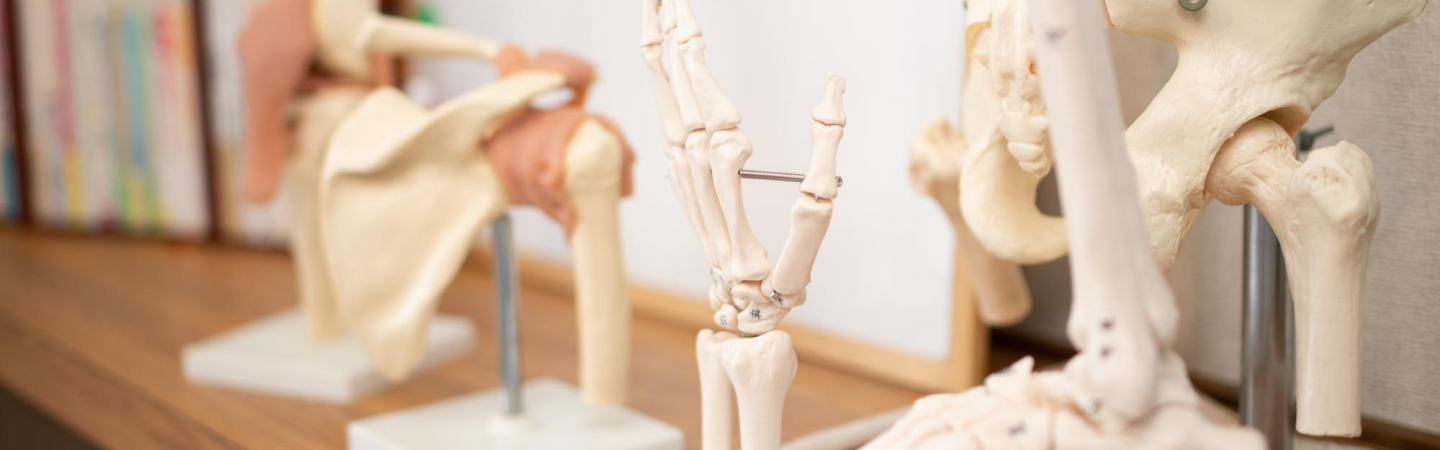
On a model of the right shoulder: the clavicle at the front, the shoulder blade at the back, and the upper arm. The tissue we’re interested in is the capsule — strong connective tissue, not unlike scar tissue, that holds the joint surfaces closely together for a stable joint. With a frozen shoulder, this capsule thickens and the joint becomes very stiff and tight — similar to a plastic cup shrivelling in heat.
It occurs in three stages. The freezing stage lasts about six weeks to nine months: pain at the top and outer arm, with movement gradually reducing in all directions (arm out to the side, hand behind the back, arm overhead). By contrast, an impingement usually reduces movement and causes pain in only one direction. The frozen stage lasts four to six months: the pain slowly decreases, but movement is reduced in all directions. The thawing stage is when movement slowly improves in all directions, and can last up to almost two years. So a frozen shoulder takes six months to two years — but these exercises can significantly reduce that time.
Effective Self-Massage
To reduce the pain immediately: reach across (demonstrating on the right), make a pincer grip with the other hand, place index and middle fingers near the tip of the shoulder blade, and dig the thumb in just under the armpit, feeling for a knot in the latissimus dorsi, which often knots up with frozen shoulders. Squeeze the knot for five to ten seconds, repeat five times. Very effective; do it once, twice, or several times a day.
Easy Exercises
Lying on your back with a dowel: with a 90-degree angle at the elbow of the affected arm, use the good hand to push the affected arm outward (external rotation), holding at the end range for 30 seconds, three to five times, daily; progress by raising the arm higher, aiming eventually to touch the floor. Then the elevation component: hold the dowel and move it up, or use the other hand to push it overhead with a straight elbow, holding 30 seconds, five times. Then, to regain reaching behind the back: lying face down, hold the dowel behind you and use the good hand to push the affected hand towards the buttocks, progressing inward, holding 30 seconds, three to five times.
Advanced Exercises
To regain reaching behind the back, stabilise a dowel against a wall, keep the elbow straight, and walk forward (extension), holding 30 seconds; then pull the affected arm across with the other hand; then, with the dowel upright, pull the affected arm upward. For outward and upward movement, use a sturdy doorframe: with a 90-degree elbow, hold the frame and rotate your body away from the affected arm (external rotation), holding 30 seconds, three to five times, progressing higher; you can fixate the elbow on the frame instead of the hand. Do these at least once a day, more if you can.
Closing
I love using YouTube to share exercises so you can help yourself. Take care of yourself, take care of someone else if you can, and bye for now.
Summary
A frozen shoulder (adhesive capsulitis) is a stiff, painful shoulder that’s restricted in all directions, caused by the joint capsule — the connective tissue holding the shoulder together — thickening and tightening, much like a plastic cup shrivelling in heat. It’s slow to resolve, typically six months to two years, moving through three stages: freezing (pain with gradually reducing movement, six weeks to nine months), frozen (less pain but stiff in every direction, four to six months), and thawing (movement slowly returns, up to two years). A useful distinction: a frozen shoulder restricts movement in all directions, whereas an impingement usually restricts and pains just one. This video demonstrates a self-massage technique for the latissimus dorsi to reduce pain (a pincer grip releasing knots near the shoulder blade), then progressive exercises using a dowel and doorframe to restore movement — outward (external rotation), upward (elevation), and behind the back, the motion people most often lose, such as doing up a bra strap or reaching a back pocket. Each stretch is held around 30 seconds, three to five times, daily. Warming the shoulder first with a warm shower or bath makes the exercises more effective. While a frozen shoulder resolves in time, these exercises aim to reduce pain and shorten recovery. Persistent or severe shoulder problems should be professionally assessed.
Frequently Asked Questions
What is a frozen shoulder and what causes it?
A frozen shoulder, medically called adhesive capsulitis, is a stiff and painful shoulder with limited movement in every direction. It’s caused by the joint capsule — the strong connective tissue that holds the shoulder’s surfaces together — thickening and tightening. The video likens it to a plastic cup shrivelling in heat: the capsule effectively shrinks around the joint, restricting movement.
What are the three stages of a frozen shoulder, and how long do they last?
Three stages. The freezing stage brings pain (often at the top and outer arm) with movement gradually reducing in all directions, lasting around six weeks to nine months. The frozen stage sees the pain ease but the stiffness remain in every direction, lasting about four to six months. The thawing stage is when movement slowly returns, which can take up to two years. Overall a frozen shoulder typically takes six months to two years to resolve.
How is a frozen shoulder different from a shoulder impingement?
The key difference is the pattern of restriction. A frozen shoulder limits movement in all directions — reaching out, up, and behind your back are all affected. An impingement typically causes restriction and pain in just one direction. So if every direction is stiff and painful, it points more to a frozen shoulder; if it’s mainly one movement, an impingement is more likely.
How do I reduce frozen-shoulder pain with self-massage?
The video shows a pincer-grip technique on the latissimus dorsi, which often develops knots with a frozen shoulder. Reaching across, you place two fingers near the tip of the shoulder blade and your thumb just under the armpit, feel for a knot, and squeeze it for about five to ten seconds, repeating five times. It can be done several times a day and gives effective pain relief.
How can I regain the movement to reach behind my back?
That motion — putting the back of the hand into the small of the back, as when doing up a bra strap or reaching a back pocket — is the one people most often lose. The video uses a dowel: lying face down or standing, you use the good arm to gently guide the affected hand up the back, progressing further over time, holding each position about 30 seconds, three to five times daily. Progressive doorframe exercises then help restore outward and upward movement.
Should I warm up before frozen-shoulder exercises?
Yes. The video recommends warming the shoulder first — a warm shower or bath for 10 to 15 minutes is ideal, or a moist heat pad — because warm tissue moves more easily, making the exercises more effective and comfortable.



GET IN TOUCH
Let’s Talk
If you would like to find out how we can help you or any other questions, please message, call or use our form to get in touch.


Monday - Friday 7:30 - 19:30

Fornham Chiropractic Clinic
Unit 10
Fornham Business Court
The Drift
Fornham St Martin
Bury St Edmunds
IP31 1SL
