



Hip Pain: Self-Tests to Find the Cause and the Right Exercises for Each
Three self-tests to identify what’s causing your hip pain, plus the specific exercises for each cause, demonstrated by a chiropractor with over 24 years of clinical experience.
Hip pain usually comes down to one of three causes: wear and tear in the hip joint, tight muscles around the hip, or weak muscles around the hip. Knowing which one you have matters, because the right exercises are different for each. This video gives you a test for each cause and then routes you to the matching exercises.
Our chiropractor Jasper Hulscher demonstrates the three tests — including a counterintuitive but important one: wear and tear in the hip is usually felt in the groin, not on the outside of the hip as many people expect. He then works through the exercises: gentle hip-mobility work and the active pigeon and pigeon pose for wear and tear; adductor, gluteus medius/piriformis, hip-hook, and iliopsoas stretches for tight muscles; and resistance-band internal rotation, abduction, and flexion for weak muscles.
The idea is simple: do the tests first, find your cause, then do the exercises that match it.
Related Reading
Is chiropractic safe? What patients in Bury St Edmunds should know
Questions
What's causing my hip pain, and which exercises should I do?
Where do you feel hip pain from wear and tear (arthritis)?
How do I test whether my hip pain is from tight or weak muscles?
What exercises help hip wear and tear (arthritis)?
What stretches loosen tight hip muscles?
What exercises strengthen weak hip muscles?
Key Takeaways (timestamped)
[00:00] Three causes of hip pain — wear and tear in the joint, tight muscles, or weak muscles. The test tells you which, and the exercises differ for each.
[00:52] Test 1 — Wear and tear — two signs: pain felt in the groin (not the outside of the hip, as many expect), and, sitting against a wall with legs straight, one foot won’t rotate inward as far as the other. (Bend the knees to rule out hamstring tightness.)
[02:31] Test 2 — Tight muscles — seated, place one ankle on the opposite knee; if the shin can’t drop parallel/to 90°, the outer-hip muscles are tight on that side.
[03:52] Test 3 — Weak muscles — a single-leg squat; if the knee collapses inward past the first toe, the hip muscles are too weak to support you.
[05:03] Wear-and-tear exercises — easy half-kneel hip mobility, the active pigeon, and the pigeon pose, building hip-joint mobility.
[08:16] Tight-muscle stretches — adductor (inner thigh/groin), gluteus medius/piriformis (outer hip/buttock), hip-hook, and iliopsoas (a very commonly tight muscle) stretches.
[14:23] Weak-muscle exercises — resistance-band internal rotation, abduction, and flexion, keeping toes pointing forward throughout. Reported as highly effective over six weeks.
Throughout: find your cause first, then do the matching exercises; some overlap and can help more than one cause.
Transcript
Introduction
If you’re struggling with hip pain, you’d probably like to know what’s causing it — wear and tear on the joint, muscles that are too tight, or muscles that are too weak. In this video I’ll demonstrate three tests to do at home to determine the cause, and then give you exercises for each cause. There’s a free worksheet linked in the description.
Test 1: Wear and Tear of the Hip Joint
Two telltale signs. First, wear and tear is felt in the groin — not the outside or back of the hip, as many expect (though a tight muscle can also cause groin pain). Second: sit against a wall, legs straight, toes up, and turn your feet as far inward as you can. Left and right should be about equal; if one stops halfway, that’s a sign of hip wear and tear. Bend the knees a little and repeat to rule out hamstring tightness.
Test 2: Tight Hip Muscles
Sit upright in a chair, knees at 90°. Place your right ankle on your left knee, aiming for the shin to be parallel to the floor. If you have that, your hip and muscle mobility is good. On my left side, the hip is stiffer — I can’t get it parallel and I feel it on the outside of the left hip, which tells me those muscles are tight.
Test 3: Weak Hip Muscles
Stand on one leg and do a single-leg squat (use a chair for balance only, not weight). Look at your knee relative to your toes: it should sit between the first and second toe. If the knee collapses inward, past the first toe, that’s a sign of hip weakness — the hip isn’t strong enough to support you on one leg.
Wear-and-Tear Exercises
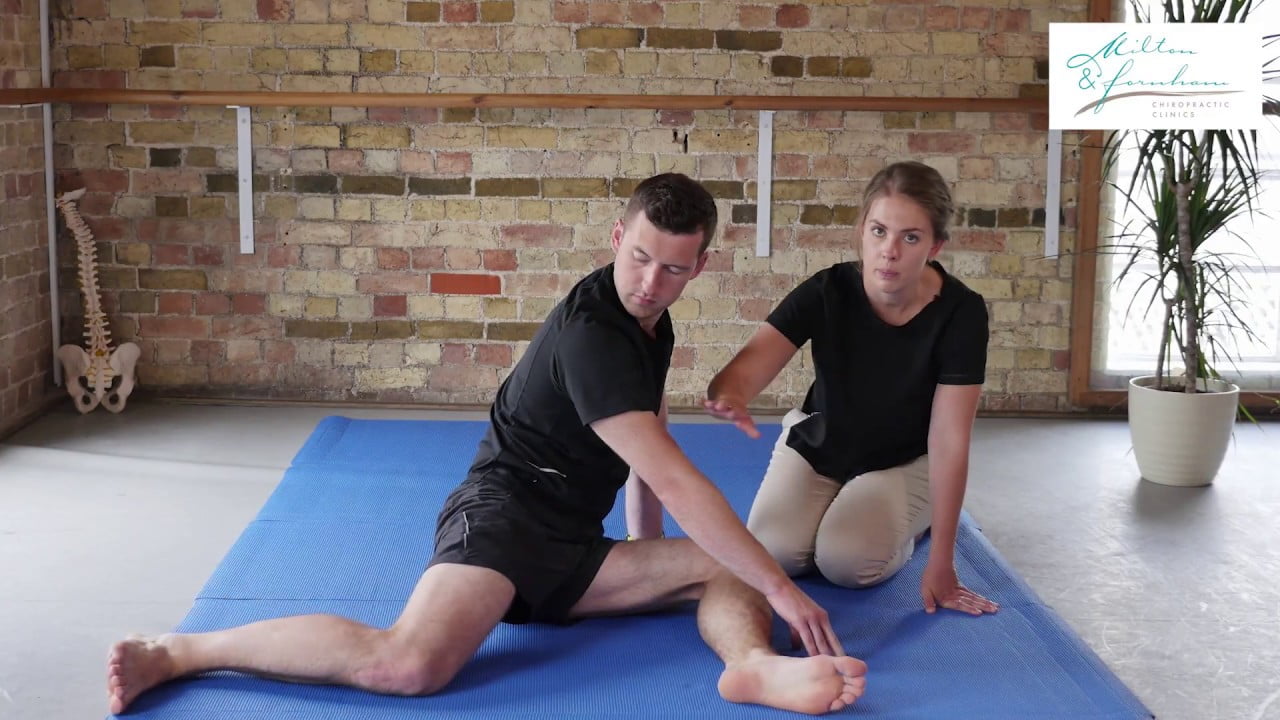
Exercise 1 — easy hip mobility: in a half-kneel, hand on the front foot, shift your body weight forward to 90° at the hip, straighten the spine, and rotate towards the hip; feel it in the outer hip and groin, hold 10 seconds, five reps. Exercise 2 — active pigeon: half-kneel with the front leg at 90°, straighten the back leg, roll over the foot and drop the leg down as far as you can, holding 10 seconds, five reps; aim to get the knee closer to the floor over time. Exercise 3 — pigeon pose: from active pigeon, move the leg outward to a 45° angle, hands forward, roll over the hip with the back leg straight, hold 10–15 seconds.
Tight-Muscle Stretches
Exercise 1 — adductor: sit against a wall, heels close to the body, drop the legs outward, hold the feet and push the knees down (lean forward to progress); feel it in the inner thighs and groin, hold 10–15 seconds, five reps. Exercise 2 — gluteus medius/piriformis: straighten one leg, place the other foot on the outside of that knee, pull the knee towards the chest and rotate the body towards that hip; feel it on the outer hip and buttock, hold 10 seconds, five reps (place a hand behind you to accentuate). Exercise 3 — hip-hook: lying on your back, hook one heel over the opposite knee and pull the leg down, keeping the upper body on the ground, hold 10–20 seconds, five to 10 reps. Exercise 4 — iliopsoas (often very tight): half-kneel on a cushion, tuck the pelvis backwards, keep upright, and move the whole body forward; feel it in the groin, hold 10 seconds, five reps (raise the arms and twist to accentuate).
Weak-Muscle Exercises
These use a resistance band and are reported to be highly effective for most people over six weeks. Exercise 1 — internal rotation: loop the band over one foot, stand on it with the other, fist between the knees to keep them together, and move the leg outward with the toes pointing forward, 10 reps, three sets. Exercise 2 — abduction: band on the ankle, straight knee, toes forward, move the leg out to the side, 10 reps, three sets. Exercise 3 — flexion: toes forward, move the leg forward and back, 10 reps, three sets. Together these build a strong hip.
Closing
I hope you found value in this video. Share it with anyone struggling with hip pain, and download the free worksheet in the description. Take care of yourself, take care of someone else if you can, and bye for now.
Summary
Hip pain usually stems from one of three causes — wear and tear in the joint, tight muscles around the hip, or weak muscles — and because the right treatment differs for each, this video pairs a self-test with a matching set of exercises. A key point is that wear and tear (arthritis) is typically felt in the groin, not on the outside of the hip as many people assume; the test for it involves rotating the feet inward against a wall and looking for one side that stops short. Tight muscles are checked with a seated figure-four (whether the shin can drop level), and weak muscles with a single-leg squat (whether the knee collapses inward). For wear and tear, the video shows gentle hip-mobility work plus the active pigeon and pigeon pose; for tight muscles, adductor, gluteus medius/piriformis, hip-hook, and iliopsoas stretches; and for weak muscles, resistance-band internal rotation, abduction, and flexion, reported as highly effective over six weeks. The approach is to test first, identify the cause, then follow the exercises that match — with some overlap between them. Persistent or severe hip pain should be professionally assessed.
Frequently Asked Questions
Where do you feel hip pain from wear and tear?
Usually in the groin — which surprises many people, who expect arthritis pain on the outside or back of the hip. Groin pain is the first telltale sign of wear and tear in the hip joint (though a tight muscle can also cause groin pain, so it’s not conclusive on its own). The video’s second sign: sitting against a wall with legs straight and rotating the feet inward, wear and tear shows up as one foot that won’t turn in as far as the other.
How do I tell if my hip pain is from tight or weak muscles?
Two quick tests. For tightness: sit upright, place one ankle on the opposite knee, and see if the shin can drop level (parallel to the floor); if it stays propped up, the outer-hip muscles are tight on that side. For weakness: do a single-leg squat and watch your knee — if it collapses inward past the first toe, the hip muscles aren’t strong enough to support you, pointing to weakness.
What exercises help hip wear and tear?
The focus is on gently restoring mobility. The video shows an easy half-kneel hip-mobility stretch, then the active pigeon (progressively dropping the leg to open the hip), and finally the pigeon pose. These are done holding around 10–15 seconds, repeated about five times, building up gradually as stiffness allows.
What stretches loosen tight hip muscles?
Four are demonstrated: an adductor stretch for the inner thigh and groin; a gluteus medius and piriformis stretch for the outer hip and buttock; a hip-hook stretch (lying down, heel hooked over the opposite knee); and an iliopsoas stretch, which is often very tight and is stretched in a half-kneel with the pelvis tucked. Each is held around 10–15 seconds and repeated five times, daily.
What exercises strengthen weak hip muscles?
Three resistance-band exercises: internal rotation (band on the foot, moving the leg outward with the knees held together), abduction (moving the leg out to the side), and flexion (moving the leg forward and back). Throughout, the toes must point forward — letting them drift out works a different muscle. The video reports these are highly effective for most people over about six weeks; do 10 repetitions, three sets.
Can one exercise help more than one cause?
Yes — there’s overlap. Some of the tight-muscle stretches also benefit wear and tear, for example. The video suggests trying the ones that match your test result first, then experimenting a little, since a stiff hip and tight surrounding muscles often go together.
Related Videos

GET IN TOUCH
Let’s Talk
If you would like to find out how we can help you or any other questions, please message, call or use our form to get in touch.


Monday - Friday 7:30 - 19:30

Fornham Chiropractic Clinic
Unit 10
Fornham Business Court
The Drift
Fornham St Martin
Bury St Edmunds
IP31 1SL
